
Some of the links below are affiliate links, meaning that I will earn a commission if you click and make a purchase. This is at no extra cost to yourself.
Snow outside. Diesel heater grumbling away in the shed. And me? Starting 500+ chilli seeds like it’s the most normal thing in the world.
I know what you’re thinking: “Shaun, it’s freezing outside, surely starting chilli seeds now is madness?” Your chilli seeds don’t actually care what’s happening outside though. They care about three things: warm compost, steady heat and not drowning. Everything else is just making your life easier so you can repeat the process next year without tearing your hair out.
This article will give you some of the basics and some of my methods with links to other resources to help you get the 2026 season off to a great start!
Table of Contents
Why I Start Seeds in the Dead of Winter
Superhot chillies need time. If you want big, healthy plants that actually give you ripe pods before the season ends, you need to get them going early. Simple as that.
The trick is understanding that you’re not growing anything outside yet. You’re just creating this little warm bubble where seeds can wake up and get cracking. If you’ve got a heated propagator (or even just a heat mat) and some grow lights, what’s happening outside becomes completely irrelevant. It’s all about the temperature where the seed is sitting – in the compost.
For more detailed info, read ‘When to Plant Peppers – The Best Time‘ and ‘Planting Super Hot Chilli Pepper Seeds: A Comprehensive Guide‘.
Three Rules for Quick and Strong Chilli Seedlings
When I’m sowing at the beginning of the season, I stick to three basics which helps everything else fall into place and gives me a brilliant start to the season:
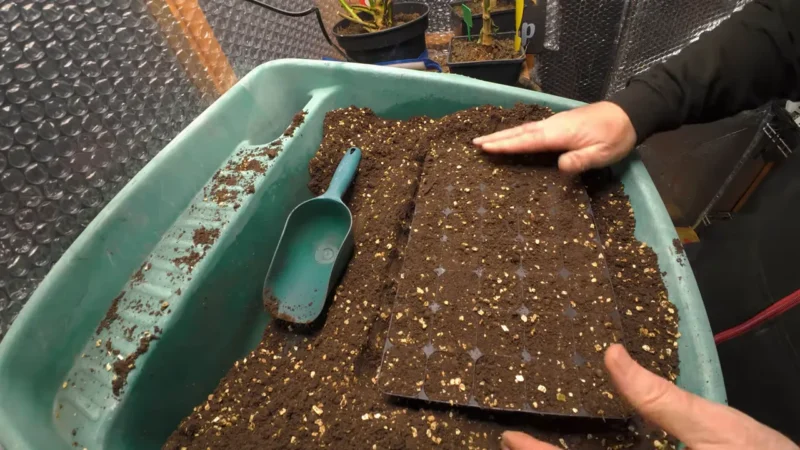
First up, warm, airy compost. Your standard multipurpose stuff can be a bit dense and heavy. Dense compost holds water. Too much water sitting around seeds slows germination and can suffocate the roots before they even get going. So I do two things to it: I sieve out the lumpy bits (so every cell feels the same), and I mix in a handful of vermiculite. Basically you’re turning “muddy sponge” into “fluffy sponge”, and seeds absolutely love fluffy.
Second, organisation. Sounds boring, I know. But when you’re sowing hundreds of seeds, if you don’t have a system, you’ll end up with labels that don’t match, varieties in the wrong cells, and this one tray of “mystery chillies” that you’ll spend all season pretending was intentional. I plan the tray layout before I plant anything: top left to bottom right, every time. I keep my seeds grouped by variety in little containers, so I’m not rummaging around mid-sow trying to find the next packet.
This is where SeedsIO really earns its keep for me. I use the tray planning feature to map out each cell before planting anything. I can tag trays with colours and IDs like “T1 (green)”. That way I know exactly what’s where, and next year I can just do it again without having to think too hard about it. Fast sowing is great. Fast sowing without mistakes is better.

Third, steady heat and humidity. I set my propagators to 28°C. Thermostats don’t hold one perfect number, mine usually floats between 27-29°C, and that’s absolutely fine. This combination of warmth and high humidity is what gets you faster, more even germination.
🔥Can it be too hot? Yes it can, but you would be surprised how hot you can go! However I would try stay below 32℃ (90℉)
The Bit Most People Skip: Warm the Compost First
This is going to sound obvious but honestly, most people miss it: cold compost is a germination killer. While you will still get germination, it will just take longer.
Before I sow anything, I put the filled trays into the propagator area for at least 24 hours. Why? Because if your compost takes a full day to warm up after you’ve already sown the seeds, you’ve lost time straight away. When you start with warm compost, you get quicker sprouting, more even germination and way less of that “why are only three seeds doing anything?” panic that we’ve all had.
My Sowing Workflow (What I Do Every Time)
Here’s exactly what I do, in order:
- Plan the tray layout in SeedsIO – get the varieties and cell positions mapped out.
- Warm the filled compost in the propagator or grow area for 24 hours.
- Make the holes with a dibber or pencil (Rule of thumb: twice the depth as the length of the seed).
- Soak seeds appropriately (longer for older seeds. Fresh seeds don’t strictly need this, but it does help).
- Label trays clearly (this saves so much hassle later).
- Into the propagator at target temperature.
That’s it. Nothing fancy. Just repeatable and effective.
Propagator Settings: what I run for Superhots
I run my 100W propagators at 28°C. These particular ones are brilliant because they help keep temperatures stable even when the potting shed is cold. The Stewart Variable propagator is a favourite of mine. But if your seed starting space is relatively warm already, then a heatmat under a cheap propagator will do the job. Just bear in mind that the power (watts) of your heat element will dictate how much warmer than the ambient temperature your seed trays can get. For example with my 100W propagators you see in the video, I can raise my temperatures at least 10°C above the ambient temperature.
For humidity, I keep a shallow layer of water in the base of the propagator. This does two useful things: it keeps humidity up (which seeds love), and it acts as a kind of thermal buffer that helps spread the heat more evenly.
Some seed trays don’t have grooves underneath though, which caught me out when I started. If they’re sitting flat on a surface with water around them, the water can pool underneath and just stay there. That leads to miserable roots and seedlings that collapse.
I used to raise trays on little spacers, which works but it’s fiddly. The better fix? Put each seed tray on a small drip tray so water can’t get trapped underneath. Simple and it actually works.
Quick Troubleshooting (When Things Go Wrong Starting Chilli Seeds)
Seeds Aren’t Germinating?
First thing to check is compost temperature. Cold compost is the most common reason seeds just sit there doing nothing. Also make sure your humidity and heat are staying steady inside the propagator. When you check the temperature, don’t rely on your thermostat. Test the temperature at the soil level.
Seedlings Wilting or Getting that Horrible Damp-off Thing?
This is usually too wet, not enough air, or poor drainage. Make sure water isn’t pooling under flat-bottom trays: raise them or use drip trays. Once seedlings pop up, start giving them fresh air by cracking the lid open.
You Planted Way Too Many Seeds? (We’ve all done it)
Welcome to the club. Pot up the strongest seedlings first, and thin the rest over time. And maybe, possibly, plan your space and pots before sowing next year? (Who am I kidding, I’ll never learn either.)
Start Chilli Pepper Seeds FAQ
What temperature to germinate superhot chilli peppers?
Aim for 28°C. Small swings between 27-29°C are completely normal and fine.
What temperature to germinate chilli peppers like Jalapeno or Cayenne?
28°C works well for these too (I stick to this for all my seeds). However you can get away with lower temperatures, down to around 20°C (68°F), but below this and your germination will be slower.
What temperature is too hot to germinate chilli peppers?
Try stay below 32°C (90°F), although chilli peppers can survive higher temperatures, its not ideal.
How should I prep the compost?
Use ordinary compost, sieve it to remove lumps, mix in vermiculite to lighten it and warm it for 24 hours before sowing.
How do I stop drowning the roots?
Make sure water can drain away from the base. If your trays are flat-bottomed, raise them on spacers or sit them on drip trays.
Do I need special equipment for hundreds of seeds?
No special compost needed. Organisation matters way more than fancy kit. A warm propagator, clear labels and a simple sowing order make it manageable.
A Quick Word on Seed Quality
Good seeds won’t fix cold compost or overwatering… but they absolutely give you a better start.
If you want good quality chilli seeds, grab them here: https://chillichumpseeds.com
Final notes
Winter seed starting is basically this: build a warm, humid bubble and keep it organised.
Warm compost. Steady heat. Decent drainage. Proper labels.
Do that, and you’ll be staring at little green hooks popping up in a few days, grinning like an absolute idiot. Which is exactly the right response, by the way.
Once your chilli seeds have sprouted, you’ll need this article Chilli Seedling Care: Expert Tips