
Some of the links below are affiliate links, meaning that I will earn a commission if you click and make a purchase. This is at no extra cost to yourself.
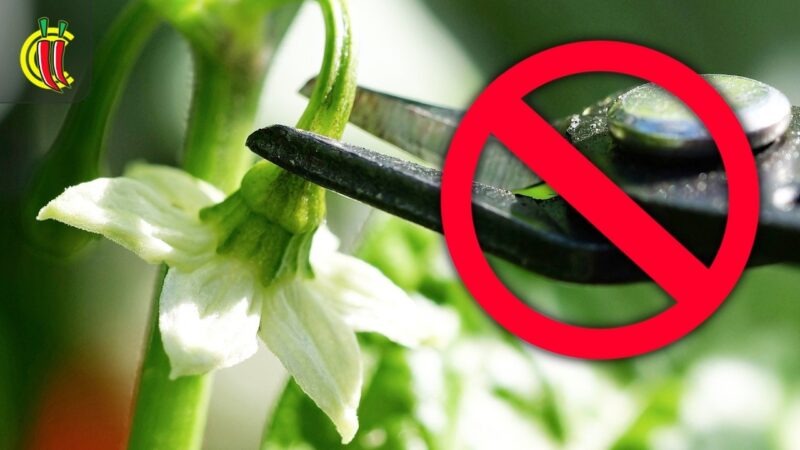
One of the most common pieces of chilli-growing advice is to remove flowers from chilli plants when they’re young. The idea sounds sensible: stop the plant from spending energy on fruit and it’ll build stronger roots, more leaves and a better structure first.
I used to find that logic convincing too. But when I looked into the plant biology and the available research, the case for removing early flowers got much weaker. The best controlled study I could find actually points the other way.
If you’re growing young chilli plants and wondering whether to remove those first blooms, the short answer is: you probably don’t need to.
Rather watch the video? Click the link below:
Table of Contents
I usually don’t pinch off early flowers
With somewhere between 400 and 500 chilli plants on the go, I’m not going around pinching flowers off every single one of them. But this isn’t just about convenience. Even if I only had a handful of plants on a windowsill, I’d still probably leave the flowers alone.
The evidence I could find doesn’t show a reliable benefit from pinching off early flowers. Under decent growing conditions, it appears to make no difference or it can even reduce your yield.
Why the usual advice sounds right but may not be
Most gardening websites explain flower removal the same way. They say a young plant has limited energy and if you remove the flowers, that energy gets redirected into leaves and roots instead of fruit. I’ve said versions of this myself in the past, because it sounds like common sense.
That explanation is appealing because it feels intuitive. Gardeners are used to thinking about plants as if they have a fixed store of energy that can be diverted from one job to another. But plants are more dynamic than that. They don’t simply hold a pot of spare energy that gets reassigned when a flower disappears.

Once you look at how plants actually produce and allocate resources, the “redirect the energy” idea becomes much less convincing.
What the research actually found
The clearest study I found was by Maboko, Du Plooy and Chiloane, published in 2012 in the African Journal of Agricultural Research. They looked at hydroponic sweet pepper production over two full growing seasons and compared three treatments: no flowers removed, the first two flowers removed and the first four flowers removed.
In the first year, the results were striking. The plants with zero flowers removed produced 4,695 grams per square metre. The plants with the first two flowers removed dropped to 3,920g and the plants with the first four removed came in at 3,781g. That’s a statistically significant yield drop of roughly 17 to 19 percent when flowers were pinched off.
In the second year, the differences weren’t statistically significant. So across two seasons, flower removal either did nothing useful or actively reduced yield. The authors concluded that not pruning flowers improved the yield.
One study isn’t the final word, of course. It was one crop type, one production system, one location. But it matters because it directly tested the advice so often repeated elsewhere.
Other sources point in the same direction. Texas A&M Extension, for example, states that under good growing conditions, removing the first bloom does not affect later yield.
A quick distinction: flower pinching is not the same as topping
It’s easy to confuse different pruning practices. Some studies have reported very large yield increases in peppers, including increases of over 100 percent in one Nepali paper. But those results were about topping, not flower removal.
Topping means removing the plant’s growth tip to encourage branching. That’s a completely different intervention with a different biological effect. I did a video on this back in 2018.
If you’ve seen dramatic claims about pruning improving yield, check whether they’re talking about pinching flowers or topping the plant. They’re not the same thing.
How chilli plants actually manage their energy
To understand why flower removal often fails to help, it helps to look at a basic concept in plant physiology: source and sink.
The leaves are the source, producing sugars through photosynthesis. Everything else acts as a sink, pulling those sugars in: growing shoots, new leaves, roots, flowers and developing fruit.
Fruit are strong sinks. They pull in sugars very effectively. But they’re not drawing from a separate fruit-only reserve. The whole plant operates on one integrated budget.
Removing a flower doesn’t magically unlock a secret stash of energy for roots and foliage. It simply removes one sink from the system. And when the demand for sugar drops, the plant may simply produce less.
Research on peach trees (Lee and colleagues, 2007) found something interesting here: when fruit were removed, leaf photosynthesis actually slowed down. With less demand from the sinks, the plant reduced production.
Plants self-regulate. If there’s less need for sugars, they may not keep producing at the same rate. So some of the “saved” energy you expect from pinching flowers may never exist in the first place.
What actually triggers a chilli plant to flower?
Another common assumption is that removing flowers somehow delays the plant’s shift into its reproductive phase. But flowering isn’t just a response to whether a few early blooms are present.
Way back in 1937, plant physiologist Mikhail Chailakhyan proposed that plants must produce a flowering signal in their leaves, something that travels to the growing tip and tells it to stop making leaves and start making flowers. He called this hypothetical signal florigen.
For decades nobody could identify it. Then between 2005 and 2007, researchers pinned it down. Florigen turned out to be real, associated with a protein encoded by a gene called FT. Peppers have their own version of this system.
In practical terms, the leaves are constantly assessing cues like day length, temperature and, crucially for chilli peppers, plant age. That age-related change is tracked by two small RNA molecules called miR156 and miR172. miR156 is high in young plants and suppresses flowering. As the plant ages, miR156 falls, miR172 rises and eventually the balance shifts enough for the flowering signal to kick in.
The key takeaway: flowering in chilli plants is largely controlled by an internal age clock. It’s not something you can reset by removing a few early flowers.
Does a small pot force a chilli plant to flower early?
Many growers have seen small, pot-bound chilli plants producing flowers and assumed the cramped roots triggered blooming. The usual explanation is that the plant feels stressed, panics and tries to reproduce before it dies.
There is a real concept called the drought escape response, where stress can push plants toward reproduction. But when root restriction has been tested in chilli peppers specifically, the results don’t support the usual gardening story.
Research by Ann C. Smith, published in HortScience, found that root restriction in chilli peppers delayed flowering rather than accelerating it.
So why do tiny, under-potted plants so often seem to flower too early?
The most likely explanation is that the plant’s internal age timer keeps advancing regardless of pot size. If a plant has been held in a small pot for too long, it may become old enough to flower before it has built enough stems, leaves and roots to look like a robust plant.
In other words, the timing mechanism keeps moving forward while the physical growth is stunted by the pot. The result is a small plant carrying flowers. That doesn’t mean the small pot triggered flowering. It means the plant reached flowering age while still undersized.
The useful mental shift
This is the most practical way to think about the whole issue:
Flowering in chilli plants is primarily an age-based countdown. Pot size affects how much plant has been built when that countdown finishes.
That clears up a lot of confusion. A small pot may not change when the flowering signal arrives, but it absolutely can change how substantial the plant is at that point. That’s why two plants of similar age can flower at roughly the same time while one looks lush and sturdy and the other looks tiny and stressed.
I still feel, from practical growing experience, that keeping a plant in a small pot can sometimes make it seem to fruit a bit sooner. But the biology suggests the reason isn’t quite what many of us assumed.
Read more about transplanting chilli seeds successfully here.
What to focus on instead of pinching flowers
What matters is getting the basics right. Pot up on time so roots aren’t held back unnecessarily. Feed well so the plant has the nutrients it needs. Give them plenty of light to support photosynthesis and strong growth. And keep them warm, especially during early development.
Get those conditions right and the plant will usually sort itself out far better than if you start chasing minor interventions that sound clever but have little evidence behind them.
The one situation where removing flowers can still make sense
Although my general advice is not to bother, there is one situation where flower removal is still fairly defensible.
If a plant has been stressed, potted up late or has just been moved into a larger pot while carrying flowers on a very small body, removing those flowers for a short period may help it settle and recover.
I’d think of this as a stress-management choice, not a proven yield-boosting technique. Even then, the likely benefit is small. If you skip it, nothing disastrous is going to happen.
Bottom line
If you’re deciding whether to remove flowers from young chilli plants, the best answer I can give is this:
Based on the available study evidence: no, it’s usually not worth doing.
Based on plant biology: no, the usual energy-redirect explanation doesn’t hold up well.
Based on practical growing experience: no, most plants do perfectly well without it.
Early flowers on a young chilli plant are not necessarily a problem that needs fixing. In most cases, the smarter move is to improve the growing conditions rather than reach for the pruning scissors.
FAQ
Should I remove the first flowers from my young chilli plant?
Usually, no. The best controlled study on this found that removing early flowers either reduced yield or made no meaningful difference. Under good conditions, leaving the flowers alone is generally the better option.
Does pinching off flowers make a chilli plant grow bigger first?
Not in the simple way people often imagine. Chilli plants work from one integrated energy budget. Removing a flower reduces one sink for sugars, but the plant may also reduce photosynthesis when demand drops. That means the expected “redirected energy” may not materialise.
Will removing early flowers increase my final harvest?
There’s no strong evidence that it will. In the pepper study cited above, removing the first flowers actually reduced yield in one season and had no significant benefit in the next.
Does a small pot force chilli plants to flower early?
Probably not in the way gardeners often describe. Research on root restriction in chilli peppers found delayed flowering, not earlier flowering. A small pot can stunt the plant so it may look too small when it reaches flowering age, but the flowering itself appears to be driven mainly by the plant’s internal age clock.
What actually triggers flowering in chilli plants?
Flowering is controlled by signals produced in the leaves, including the FT-related florigen system. In chilli plants, age appears to be especially important. As the plant matures, molecular signals shift until the growing tip switches from making leaves to making flowers.
Is topping the same as removing flowers?
No. Topping removes the growing tip to encourage branching, while flower pinching removes blooms. They are different interventions with different effects, so results from topping studies should not be used to justify flower removal.
When might removing flowers still be reasonable?
If a plant is stressed, has been potted up late, or is flowering heavily on a very small frame just after repotting, removing flowers briefly may help it recover. Even then, the benefit is likely to be modest.
If your young chilli plant is flowering, don’t assume that means something has gone wrong. Most of the time, the best response is simple: keep it healthy, keep it growing and let the plant do what it’s been programmed to do.