
Some of the links below are affiliate links, meaning that I will earn a commission if you click and make a purchase. This is at no extra cost to yourself.
Every year I get asked about mycorrhizal fungi for chilli plants. Should I use it? Is it worth the money? Does it actually do anything?
Mycorrhizal fungi absolutely work. The science behind them is solid and the relationship they form with plants is one of the oldest partnerships in nature. But they do not perform equally in every growing situation. If you grow chillies in raised beds or in the ground, they can be genuinely valuable. If, like me, you grow mostly in pots, the benefits are still there, but they are usually smaller and more dependent on how you manage your plants.
Rather watch the video? Click the video below:
Table of Contents
What are mycorrhizal fungi?
The name is a clue. “Myco” comes from the Greek for fungus. “Rhiza” means root. Put them together and you get fungus-root.
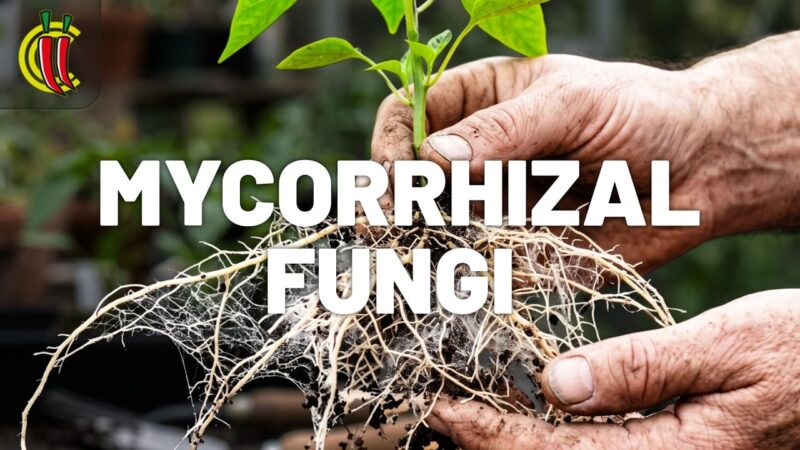
Mycorrhizal fungi live in and around plant roots. Over 90% of plant species on Earth form these associations. This is not some modern gardening trick. It is the way plants have been growing for roughly 400 million years. We are the newcomers with our fertilisers and grow tents. The fungi were here first.
For chilli growers, the type that matters is arbuscular mycorrhizal fungi, often shortened to AMF. These are endomycorrhizal fungi, meaning they grow inside the root cells. Once inside, they push through the cell wall and form tiny branched structures called arbuscules. Think of them as microscopic exchange points.

At each one, a trade is happening. The plant sends sugars down to the fungus, carbon it produced through photosynthesis. In return, the fungus sends back phosphorus, zinc, copper and water.
The key advantage is reach. The fungal hyphae, these incredibly fine threads, can spread 10 cm or more into the surrounding soil, accessing nutrient pools the roots would never physically touch. The plant feeds the fungus and the fungus extends the plant’s effective root system. Both sides benefit.
Does mycorrhiza actually help chilli plants grow?
For chillies and peppers, yes. Research shows measurable benefits, although the size of those benefits varies depending on variety and growing conditions.
Yield and biomass improvements
A field study published in 2023 from an organic farm in Kansas tested AMF inoculation on five chilli pepper varieties over a full growing season. The inoculated plants produced 2% to 8% more biomass, with an average improvement of 3.7% at final harvest.
3.7% may not sound dramatic at first. But over hundreds of plants, it adds up. The study also showed that different varieties responded differently. Shishito and Islander Bell responded well, while Mammoth jalapeño barely budged. That suggests there is a genetic component to how well a given pepper variety partners with the fungi.
Can mycorrhizal fungi for chilli plants reduce fertiliser use?
A three-year study from Poland on sweet peppers (Capsicum annuum, grown in an unheated greenhouse in central-eastern Poland) found that inoculating plants during seedling production allowed growers to reduce mineral fertiliser by 50% to 75% without a statistically significant drop in yield or fruit quality. That data was published in MDPI Agriculture in 2023.
Cut your fertiliser by half to three quarters, with no loss. The fungi made up the difference. If that holds true in your own setup, they are not just a minor add-on. In the right system, they become part of the core fertility strategy.
Better drought tolerance for chilli plants
Research also points to improved drought tolerance. Because the fungal network improves water uptake and helps plants use available moisture more efficiently, inoculated plants can be more resilient when watering is less than ideal.
If you have ever come back from a weekend away and found your plants wilting, a well-established mycorrhizal network could be the difference between recovery and loss. For anyone growing chillies through warm spells, in greenhouses, or in the middle of busy weeks when watering slips, that extra buffer can make a noticeable difference.
Do mycorrhizal fungi work in pots?
This is the part many product labels conveniently skip.
Mycorrhizal fungi can help potted chillies, but pots are a much tougher environment for them than open ground or raised beds. I grow 400 to 500 plants and the vast majority are in pots, so I cannot just shrug and say it works better in the ground. I have to deal with the reality of pot growing.
What I have found is that the benefit in containers is real, just more modest. And it depends on how you grow. There are three main reasons pots make life harder for the fungi.
1. Temperature swings
Pot walls heat up and cool down far faster than soil in the ground. Mycorrhizal spores generally germinate best between 18°C and 25°C. On a hot day in a greenhouse, a dark plastic pot can push well above that range. When temperatures climb too high, fungal activity slows, the fungi go dormant, or parts of the network die back.
2. Heavy feeding suppresses the relationship
This is one of the most important points to understand. Mycorrhizal fungi exist to help the plant source nutrients. If you are regularly applying synthetic fertilisers, especially anything high in phosphorus, the plant has less reason to maintain the partnership. Why would it pay a fungus in sugars for a service it does not need?
As nutrient abundance increases, the plant sends less carbon to the fungus. The relationship weakens. So if your growing style relies on frequent synthetic feeding, inoculating with mycorrhiza is often poor value.
3. The fungi need time to establish
Colonisation is not instant. It takes weeks for a network to build. In a UK growing season, by the time the fungi are fully active, you might already be into peak fruiting. And if you are potting up multiple times, each move disrupts the hyphae and sets the process back.
In other words, pots often combine all the things fungi dislike: unstable temperatures, frequent disturbance and easily over-supplied nutrients.
Why raised beds and ground soil give better results
Compare all of that to a raised bed or border. The soil is more stable, temperatures fluctuate less and the root zone is disturbed far less often. Once the fungal network is established, it persists in the soil instead of being broken apart by repotting.
I have a couple of raised beds in my polytunnel and I inoculate those. I did it once and the fungi are still there, because the soil is not disturbed, the temperature is stable and the network carries on year to year. That is where mycorrhizal fungi really earn their keep.
If you grow chillies in raised beds, in the ground, or in any long-term minimally disturbed soil system, mycorrhiza is well worth using.
Should you still use mycorrhizal fungi in pots?
Usually, yes, but with realistic expectations.
If you grow in a rich organic mix and feed moderately, there is a sensible case for using them. The fungi have room to contribute and can help with nutrient scavenging, water access and general plant health.
If you feed heavily with synthetic fertilisers, especially high-phosphorus products, the return is likely to be much lower. You may be adding something your growing system is actively suppressing.
Either way, the cost is so low it is hard to argue against it. A tub lasts ages and you really do not need a lot per plant. That makes it easy to justify as part of a broader, moderate-input approach.
How to apply mycorrhizal fungi to chilli plants
Application matters more than most people realise. The spores need physical contact with the roots to colonise them.
The best approach is to apply the inoculant directly to the root ball, or into the planting hole, when you transplant. That way the roots are in immediate contact with the spores.
I do also add some to my compost mix, and that is fine. But sprinkling it on the soil surface is a waste. The spores sitting on top of the pot are not going to colonise anything.
Check your labels: the Trichoderma warning
Not all mycorrhizal products are created equal, and this is a detail worth paying attention to.
Some mixed inoculant products include Trichoderma fungi alongside the mycorrhizal species. Trichoderma can be useful in other contexts, but there is a catch. It is a fungus that feeds on other fungi.
If your product contains, say, 10,000 Trichoderma spores per gram and only 100 mycorrhizal spores, the Trichoderma is going to eat the mycorrhizal fungi before they have had a chance to colonise your roots. You end up paying for something that defeats its own purpose.
Read the label. Check which species are included, look at the spore counts and make sure the mycorrhizal component is not being undermined by other ingredients.
The bottom line on mycorrhizal fungi for chilli growers
Mycorrhizal fungi form a genuine symbiotic relationship with your chilli plant’s roots. The plant provides sugar and the fungi provide phosphorus, water and other nutrients in return.
Research on peppers shows yield improvements, reduced fertiliser needs and better drought tolerance. For raised beds and ground soil, absolutely use it. That is where it shines.
In pots, still use it. It is cheap and it will not hurt. But keep synthetic feeds moderate, apply it directly to the roots and understand that the returns will be a bit more modest.
FAQ
Do mycorrhizal fungi work for chilli plants?
Yes. Research on peppers shows benefits including improved biomass, better drought tolerance and, in some systems, significantly reduced need for mineral fertiliser. The size of the benefit varies depending on the variety and growing conditions.
Are mycorrhizal fungi worth using in pots?
They can be, but expectations should be realistic. Pots create harsher conditions for fungal networks because temperatures fluctuate more, roots are disturbed during potting up and heavy feeding can suppress the relationship. In organic or moderately fed systems, they are more likely to be useful.
Why do raised beds benefit more from mycorrhiza?
Raised beds provide more stable temperatures, less disturbance and a soil environment where fungal networks can persist over time. That gives mycorrhizal fungi a better chance to establish and keep working year after year.
How should I apply mycorrhizal fungi?
Apply the inoculant directly to the root ball or into the planting hole during transplanting. The spores need physical contact with roots to colonise them. Sprinkling it on the soil surface is much less effective.
Do synthetic fertilisers stop mycorrhizal fungi from working?
They can. Regular use of synthetic fertilisers, especially high-phosphorus feeds, reduces the plant’s reliance on the fungi. When nutrients are already abundant, the plant sends less carbon to the fungi and the partnership weakens.
Should I avoid products that contain Trichoderma?
Not necessarily in every case, but read the label carefully. Trichoderma feeds on other fungi. If a product has high Trichoderma spore counts and low mycorrhizal spore counts, the Trichoderma may consume the mycorrhizal fungi before they can colonise your roots.
What is the best temperature for mycorrhizal fungi?
Mycorrhizal spores germinate best between 18°C and 25°C. In pots, especially dark plastic ones in a greenhouse, soil temperatures can easily exceed this range on warm days, which slows or halts fungal activity.