
Some of the links below are affiliate links, meaning that I will earn a commission if you click and make a purchase. This is at no extra cost to yourself.
When the weather turns, you don’t have to say goodbye to your chilli plants. Overwintering chilli plants keeps them alive through the cold months so they’re ready to go again in spring, often giving you chillies much earlier than plants grown from seed. We’ve had unusually high temperatures this year right up until now, so a lot of growers still have plants with new flowers coming and plenty of late fruit. That makes overwintering a great option, because those plants get the chance to keep going instead of being lost to the first frost. Here’s how I do it, both in a small greenhouse and on a windowsill indoors.
Why Overwinter Chilli Plants?
Chilli plants are perennials. Where they come from they keep growing for years, but here in the UK the frost finishes them off, so most of us treat them as annuals and start again from seed every year. Overwintering just means keeping a plant alive through the cold months so it can carry on next season.
An overwintered plant already has a big root system and a woody stem, so it gets going much earlier in spring and you can be picking chillies while your seedlings are still catching up. It also gives slow plants a longer season to work with. And if a plant has done something weird and interesting this year, keeping it is the only way to find out what it does next.
In this guide I’ll show you the two ways I usually overwinter my chilli plants. Most of them go into my small greenhouse, insulated and kept frost free with a little heater. Others come indoors to sit on a windowsill.
Table of Contents
Greenhouse or Windowsill?
Where your plant spends the winter changes how you prepare it, so decide that before you start cutting.
| Greenhouse | Windowsill | |
|---|---|---|
| Pot | Keep the big pot | Move to a smaller pot |
| Roots and compost | Leave the roots alone and top dress with fresh compost | Clean off the old soil, trim the roots and repot in fresh compost |
| Pruning | Cut back hard | Cut back to a compact shape, just above a node |
| Protection | Bubble wrap and a small heater on a thermostat | A sunny windowsill |
| Watering | Light, only when the compost has dried out | Light, only when the compost has dried out |
Which Chilli Plants Should You Overwinter?
You don’t need to keep everything. Space and heat are limited over winter, so I only keep a handful of plants each year and pick each one for a reason. These are the reasons I usually go by:
- Something unusual is going on. If a plant has done something odd, like fasciation where the stems flatten and go a bit Frankenstein, overwintering it lets you see whether it happens again next year.
- You want an early harvest. An overwintered favourite will give you chillies earlier than anything grown from seed.
- The plant clearly wants to live. If it’s still pushing out new growth after you’ve cut it back, it’s worth giving it a chance.
- It ran out of season. Some plants give you very little in locations with a short summer. Overwintering gives them a head start and a longer season next year.
- You just like it. If a plant has a look or character you like, that’s a perfectly good reason to keep it too.

Whatever you pick, go for plants that are healthy going into winter. A struggling plant has a much harder time coming through the cold months.
How to Overwinter Chilli Plants in a Greenhouse
All you’re trying to do in a greenhouse over winter is keep the frost out, so the plants stay alive while they sit dormant.
- Clear it out. Empty the greenhouse completely so you have room to work and space for the plants.
- Insulate with bubble wrap. Lining the inside with bubble wrap makes a massive difference. It holds the heat in, so a small heater can warm the space up quickly and doesn’t have to work as hard. It doesn’t have to be perfect, it just needs to line the inside. You can see how I put mine up in the video.
- Add a small heater. A basic bar heater at the bottom of the greenhouse is fine. It isn’t very powerful and it doesn’t need to be, because all it has to do is keep the frost away. With the insulation in, a small heater goes a long way.
- Control it with a thermostat probe in the soil. This is the bit I’d really recommend. I plug the heater into a thermostat, and the thermostat’s probe goes into the soil of one of the pots rather than hanging in the air. I set it to switch the heater on when the soil drops below 3°C. You can nudge that up or down depending on how cold your winters get. Why the soil and not the air? Air temperature drops and changes really quickly. Soil holds its temperature much longer, so even if the air gets below 0°C, the soil in the pot can still be fairly warm. Measuring the soil means the heater only comes on when the plant actually needs it, which saves you running it all night for nothing. Just remember the probe only tells you how warm that one pot is. Warm compost doesn’t mean the branches are safe, so keep a cheap thermometer near the plants as well and check it on cold nights.
- Keep the plants in big pots. Big pots full of compost have a lot of thermal mass, so they hold onto their temperature for longer. If the temperature dropped to 0°C, a small pot would cool down far quicker than a big one. That’s why I leave my greenhouse plants in their large pots.
Pruning, Watering and Feeding Chillies Over Winter
Cut them back hard
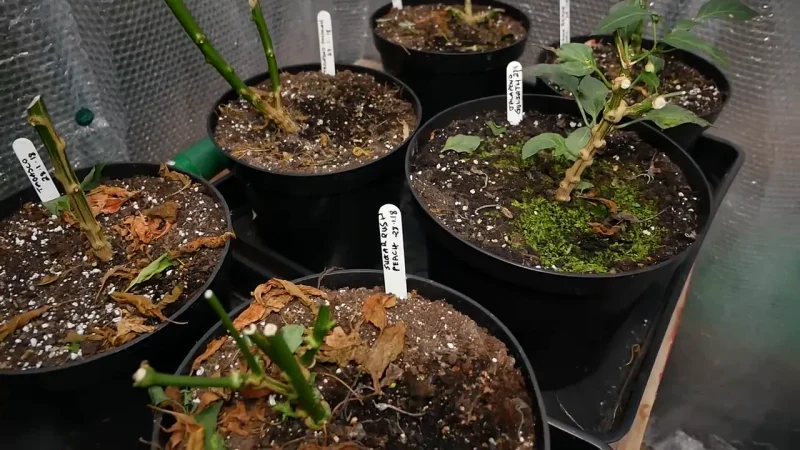
I trim my overwintering plants right back, and it’s pretty drastic. A plant going into winter is going dormant, so it doesn’t need all that leaf and branch, and a smaller plant is much easier to look after. Leaving a bit of green on is fine too. If you’re short on time, this bitesize video outlines the steps you need to take to overwinter chilli plants.
Refresh the top of the compost
Normally I’d take my plants out of their pots, strip off the old soil, trim the roots and put them into much smaller containers. That works well indoors where I can control the temperature. Out in the greenhouse I want the thermal mass of the big pots, so instead I scrape away some of the topsoil and add a top dressing of fresh compost. That will be enough to keep them going for a good while.
Water very lightly
Overwintered chilli plants are dormant. They aren’t growing, so they need very little water or nutrients. I check mine every week or two and only water if the compost has dried out. Don’t water just because it’s been a week.
Overwatering is the main thing to watch. Roots don’t like sitting wet, in winter or summer, and too much water is the easiest way to kill the roots and lose the plant.
Feed once, a couple of months in
I give them a small feed about two months in, if they look like they need it. Until then the fresh compost on top is plenty.
How to Overwinter a Chilli Plant Indoors
If If you don’t have a greenhouse, a windowsill works. This is how I get a plant ready to come indoors.
- Trim it back first. Cut the plant down to a size that will suit a small pot on a windowsill. It’s a bit of a shame if there are still chillies on it, but long branches have to go.
- Take it out of the pot. Gently work off as much of the old soil as you can. Don’t worry if a few roots come off, chilli plants are very resilient.
- Wash the roots. Hose off the rest of the soil so you can check the roots are healthy.
- Trim the roots. Use a clean, sharp pair of scissors and cut the root ball back so it will fit comfortably in its new, smaller pot.
- Mix your compost. General purpose compost with a couple of handfuls each of perlite and vermiculite is all you need.
- Repot into a smaller pot. Pop the plant in and fill around it.
- Prune for a compact shape. Look at the size of the pot and trim the top growth back to match. Cut just above a node, as that encourages the plant to push out new shoots. You want a compact, bushy plant with lots of little growth points, rather than long spindly stems.
- Put it in a sunny window. Mine goes on a south facing windowsill, which gets sun most of the day here in the northern hemisphere (if you’re in the southern hemisphere, go for a north facing window). It doesn’t need as much light as a plant in full growth, because the goal is just to get it through winter, with no fresh chillies expected.
Come spring, you can keep it going as a small indoor plant, or pot it up into something bigger and let it grow.
Common overwintering mistakes
- Overwatering. The plant is dormant and barely drinking. This is the easiest way to lose an overwintered chilli.
- Not cutting back enough. A big leafy plant is harder to keep alive and takes up space you don’t have.
- Relying on insulation alone. Bubble wrap holds the heat in, but without a small heater a cold snap can still get through.
- Treating both methods the same. Indoor plants do better in smaller pots, while greenhouse plants are better off staying in their big ones.
- Expecting every plant to make it. Some won’t, and that’s fine. Treat your first winter as a bit of an experiment.
What Happens Next?
The small greenhouse won’t stay quiet for long. I start my chilli seeds in January, so by the time the days start getting longer, the overwintered plants are waking up alongside a fresh batch of seedlings.
Once they’re growing again, feed and water them as you would any other chilli plant, and pot the indoor ones up into something bigger if you want a full crop from them.
Look out for my newer overwintering video coming soon, where I show you how I plan to overwinter my 2026 chillies in my new indoor growing space, the Germinator 2.0.
If you’re thinking of starting chilli seeds in 2027 or you want some tips and tricks from a seasoned chilli grower, check out my seed starting guide.
Overwintering Chilli Plants: FAQ
Can chilli plants survive winter outside in the UK?
No. Frost will kill them. They need to be somewhere frost free, like a heated greenhouse or a windowsill indoors.
What temperature do overwintered chilli plants need?
They just need to stay above freezing. I set my greenhouse heater to come on when the soil in the pot drops below 3°C.
How often should I water chilli plants in winter?
Very little. I check mine every week or two and only water if the compost is dry. The plants are dormant, and overwatering can kill the roots.
Should I cut back chilli plants before winter?
Yes. I cut mine back hard. A smaller plant is easier to keep alive while it’s dormant.
Do I need to repot chilli plants for winter?
If they’re coming indoors, yes: trim the roots and move them into a smaller pot. If they’re staying in a greenhouse, I’d leave them in big pots, because the extra compost holds its temperature for longer.
Do overwintered chillies need feeding?
Hardly at all. A top dressing of fresh compost is enough for a while, and I might add a small feed about two months in.