
Some of the links below are affiliate links, meaning that I will earn a commission if you click and make a purchase. This is at no extra cost to yourself.
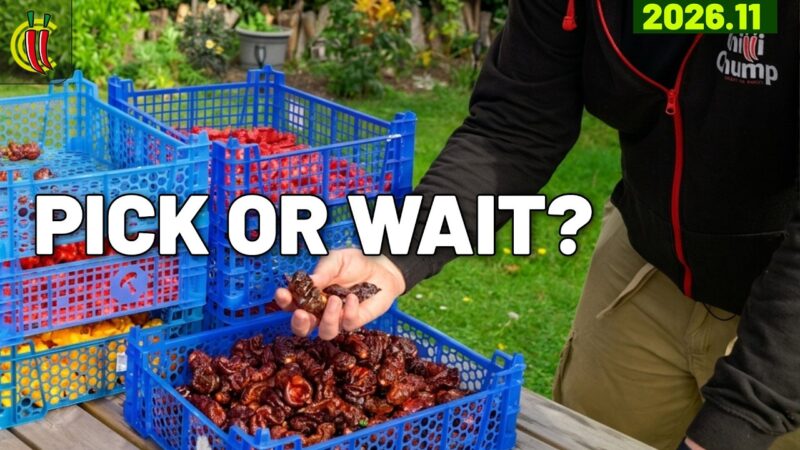
The best time to pick most chillies is once the whole pod has reached its final ripe colour and still feels firm and healthy. If you want green chillies, wait until the pods are fully grown and just about to change colour. If you’re saving seeds, leave a few chosen pods on the plant a bit longer.
I’ve been growing chillies for more than twenty years, and this is still one of the questions I get asked most. It sounds simple enough. The tricky bit is knowing what the final colour actually is. Not every chilli finishes red, and a pod can look ready on one side while the other side is still catching up. I’ve got yellow, peach, orange, chocolate and purple pods across my greenhouses and polytunnel this year, and they’re a good reminder that spotting a bright colour isn’t always enough.
Here’s how I decide when to harvest chillies, with examples from my own plants.
How to Tell When a Chilli Is Ripe: My Three Checks
Before I pick anything, I ask myself three questions.
- Colour. Has the whole pod reached the colour I expect for that variety?
- Condition. Is it still firm, with no insect damage, disease or blemishes that worry me?
- Purpose. What’s it for? Eating, pickling, sauce, drying or seed saving?
One plant can be carrying pods for different jobs at the same time. A firm chilli that has just ripened might be perfect for sauce, while an older pod that’s starting to soften could be one I’ve left on purpose for seeds.
Table of Contents
Learn the Final Ripe Colour of Each Variety
My best tip is to leave one pod on the plant until it starts to go past its best. I think of it as sacrificing a pod so I know what the rest should look like.
As that chilli fully matures and begins to soften, you can see just how deep the colour goes for that variety. Then you’ve got a reference to compare the others against, and you can pick them while they’re still firm.
This really helps with a variety you haven’t grown before, a new cross, or chocolate chillies. The first colour change you see isn’t always the last one.
Peach and Cream Chillies: Check the Colour All Over
My Fried Chicken chilli is a good example. It ripens to somewhere between cream, peach and orange, so you’re never waiting for red. A half ripe pod can feel nice and firm and look close to ready, but put it next to a fully ripe one and the difference is obvious.

I’m looking for an even colour across the whole chilli. A pale patch, or a bit of green at the tip, tells me it still has some ripening to do.
You could pick that half coloured pod and still get some flavour out of it. I’d rather give the sugars time to develop, so the fully coloured one is the pod that goes in my harvest.
Yellow Chillies: Wait for the Deeper Shade
With my Citron plants I know I’m waiting for yellow. Even so, there’s a difference between a pod that has only just turned pale yellow and one that has gone a deeper, richer yellow.
Check the pods lower down the plant as well as the ones at the top. On this plant some of the lower fruit is further along. The deep yellow pods that are still firm are the ones I’d call ready.
Orange Chillies: Is It the Final Colour or Just a Stage?
Some chillies finish orange, including certain habaneros. Others go through orange on their way to red.
A new cross I’m helping South Devon Chilli Farm assess shows this nicely. The pods start green, go almost completely orange and then turn a rich red. Picking at orange would mean harvesting before it’s fully ripe.
My Goronong goes the other way. The pods start pale green and finish orange. Once they’re orange all over and still firm, that’s when I pick them.
So I never treat orange on its own as a sign of ripeness. I need to know first whether that’s where the variety ends up.
Chocolate Chillies: Turn the Pod Over
Chocolate Warthog pods are really easy to pick a bit early. A pod can look brown enough at first glance and still have lighter patches that need more time.
Turn the pod round and look at it from a few angles. I want that deep, dark chocolate colour all the way round, without a dark face on one side and a lighter one on the other.
In a recent harvest, some of my Chocolate Warthogs were exactly where I wanted them and some were a little lighter. The lighter ones were still fine for sauce, but they weren’t at my preferred picking stage. Ideally I want a firm pod with full colour all over.
Look out for the Chocolate Warthog seeds in the seed store from the end of October. If you want to be notified once the new varieties and the 2027 ChilliChump Seed Kit are released, make sure you subscribe to the newsletter at https://chillichumpseeds.com/newsletter/
Can You Pick Chillies When They’re Green?
Yes. Chillies don’t always need to be fully ripe before you pick them. Jalapeños are the obvious example, and Kashmiri Mirch can be harvested green too.
What matters is the difference between a fully grown green chilli and a very young, undersized one. Pick too early and you won’t get the flavour you’re after.
My preferred time to pick green chillies is just before the pod starts to change colour, or when the first slight blush shows. That tells me the chilli has developed fully while it’s still mostly green.
Kashmiri Mirch: Green for Sauces, Red for Spice
Kashmiri Mirch is a Capsicum annuum variety that gives me two options. Green pods go into green sauces and certain curries. Red pods are what I like for chilli flakes and ground spice.
For a green harvest I look for a well developed pod that’s just starting to blush, and I leave the very young ones to keep growing.
For drying and grinding I wait for a deep red. A pod can look convincingly red and still get darker, so a reference pod is especially handy here. I want the colour of a fully mature chilli, picked before it goes soft.
Jalapeños: Green or Red
Most people think of jalapeños as green because that’s how they’re usually eaten, but they do ripen to red.
On my CC Jalapeño plants I pick the green pods just as they’re about to turn. Catching that moment is harder than picking a fully red chilli, but the flavour is better than if you harvest too early.
Some of these pods have obvious corking, the pale lines that appear when the fruit grows quickly. I don’t use corking to judge ripeness. I look at it separately from the colour change.
For red jalapeño sauces, like the sriracha style sauce I make with ripe red pods, I wait until the colour has finished changing and the fruit is still firm. A mostly red pod with a green patch left on it isn’t quite there yet.
My CC Jalapeños have also been unusually hot this season, roughly twice as hot as I’d normally expect. That’s just something I’ve noticed with this crop, though, and heat isn’t a reliable way to tell if a chilli is ripe. I still decide when to pick based on how developed the pod is, its colour and its condition.
Does Purple Mean a Chilli Is Ripe?
Purple takes a bit of reading. Lots of chillies start green, and some pick up purple colouring in strong sun before moving on to their final ripe colour. I think of it as a bit like a suntan.
So a purple pod isn’t automatically ready to pick.
KS Starling: Several Colours Along the Way
My KS Starling plants show how complicated the colour sequence can get. The pods start green, go through a pale yellow stage and then pick up orange or red tones as they ripen. Some also show purple, and you can see a little purple on the stems too.
I keep checking how they’re getting on and don’t assume one eye catching colour is the end point. When I need to double check which plant I’m looking at, I use my SeedsIO plant and seed tracker to confirm the variety.
Buena Mulata: Naturally Purple, Ripens to Red
Buena Mulata is different again. Its young pods are naturally purple, whether or not they’ve had much sun, and they eventually ripen to red.
It’s one of my favourite plants just for how the pods look, but that purple stage isn’t when it’s ripe. For fully ripe fruit or mature seed pods, I wait for red.
Why Are My Chillies Taking So Long to Ripen?
Every plant ripens at its own pace, so don’t expect the whole garden to be ready at once.
A lot of it comes down to species. Capsicum annuum varieties like jalapeños and cayennes are usually the quicker ones. Capsicum chinense, which covers habaneros and nagas, tends to need a much longer season and is slower to ripen. Capsicum frutescens, the piri piri and Tabasco group, can be fairly quick, but it depends on the variety and your conditions. If you know which species you’re growing, you’ll have a better idea of when to expect ripe pods.
Aji Lemon Drop, a Capsicum baccatum variety, produces loads of yellow fruit but can take a bit longer. I often find these plants start ripening more readily once the temperatures drop a little.
On my plants there are plenty of green pods hanging alongside the first yellow ones, and that on its own isn’t something to worry about. When I did this garden update (end of September 2026), I reckoned there was still about a month of growing time left here in the UK. That was a rough guess for the season, so don’t treat it as a deadline.
Tabasco plants test my patience as well. They can take ages to reach the ripe colour, even when the plant is covered in fruit.
Use a Colour Reference for More Consistent Harvests
The people who make Tabasco sauce use a colour reference called Le Petit Bâton Rouge, which means the little red stick. They hold the peppers up against it and pick them once they match.
I like that idea for any variety you grow year after year. Once you know the right ripe colour, you could paint a stick to match and use it as a simple picking guide.
It helps with varieties that pass through murky inbetween shades too. My Chinesischer Runzelhaut starts green, goes through a muddy brownish red and then finally turns a much clearer red. I wait for that final red while the pods are still firm, so I don’t mistake the in between colour for fully ripe.
If you grew Chinesischer Runzelhaut from the ChilliChump seed kit, keep an eye out for that murky stage on your plants too.
Do You Need to Pick Ripe Chillies Straight Away?
Not always. For sauces, cooking and drying, I like to pick chillies just as they reach their final colour, because that keeps them fresh for longest. Even so, a healthy ripe chilli won’t be ruined the moment it changes.
My firm orange Goronong pods are a good example. They’ll stay in good condition on the plant for a while, which gives me some leeway to wait and do a bigger harvest.
In my growing conditions some ripe pods stay firm for about a week, or even two, before they start to soften. I treat that as a handy window, though it won’t be the same for every variety or every growing space.
You’ll also get more than one flush of fruit, so a plant can give you several harvests. There’s no need to cram every pod into one picking day. If you do decide to wait and pick more in one go, keep an eye on the ripe ones to make sure they’re still in good shape.
Be more careful once the weather turns. When temperatures drop, pods left on the plant too long can start to go mouldy or rot. Once that happens, the flesh is no good for the kitchen and the seeds can’t be relied on either.
If you’re looking for inspiration, check out my hot sauce recipe playlist on YouTube or take a look at the spicy recipes on the website.
When to Pick Chillies for Seed Saving
Saving seeds is a different decision. When I’m saving seeds, I deliberately leave a few healthy pods on the plant past the point I’d normally pick them to eat.
My Malawian Piquante type piquant peppers show the difference well. A fresh, firm ripe pod is one I’d eat or pickle using my pickled pepper recipe. Some older pods stay on the plant because I want the seeds inside to have plenty of time to mature.
Letting those seed pods go a bit overripe gives me fully formed, mature seeds for next season. I do the same with lots of my plants, including jalapeños.
Overripe doesn’t mean damaged or diseased. I never pick damaged pods for seed saving. A pod can be dry, wrinkled and not very appetising while still being perfectly healthy, like a fully red Buena Mulata seed pod. When I open up a good seed pod, I expect the seeds inside to be a light colour.
There’s a limit, though. Pick your seed pods once they’re a bit soft and wrinkly, and don’t wait until they start to rot. In cold or wet weather an overripe pod can go mouldy quite quickly, and seeds from a mouldy pod aren’t worth keeping.
I keep those seed pods completely separate from the firm fruit I want for sauces.
Picking the Best Chillies for Cooking and Fermenting
For eating, pickling, sauces, drying and spices, I want firm chillies with no obvious insect damage, disease or blemishes that worry me.
I’m especially fussy when the harvest is going into a fermented hot sauce. It’s worth starting with pods in the best condition you can, so the soft seed pods never go in with my sauce chillies.
Choosing good pods is a solid starting point, but it isn’t a full fermentation safety process on its own. My rule at harvest time is simply to keep the sound, firm fruit for food.
If you end up with more chillies than you can use fresh, have a look at my guide to what to do with a chilli glut, where I go through freezing, drying and fermenting your harvest.
My Chilli Harvest Checklist
Before I pick a pod, I run through this quick list.
- Know the variety’s final colour. If you’re not sure, leave one reference pod on the plant until it starts to soften.
- Check the whole chilli. Look at the tip, the underside and the other side for any areas still changing colour.
- Let green chillies develop. Aim for just before the colour change, or the first slight blush.
- Pick for the job. Firm, healthy pods go to the kitchen. Some older healthy pods can stay on for seeds.
- Wait if you want, but keep checking. It’s fine to save up for a bigger harvest as long as the pods stay firm and healthy.
There isn’t one colour or one date that tells you when to pick chillies. Learn how each variety ripens, check the whole pod and decide what you want to use it for. Once you’ve got that reference point, spotting a chilli at its best gets a lot easier.
Chilli Harvesting FAQs
How do I know when my chillies are ready to pick?
Most chillies are ready when the whole pod has reached the final ripe colour for that variety and still feels firm. If you’re not sure what that colour is, leave one pod on the plant until it starts to soften and use it as your reference.
Can you pick chillies before they turn red?
Yes. Jalapeños and Kashmiri Mirch are often picked green. Wait until the pod is fully grown and just about to change colour, or shows a slight blush, so you get better flavour than from a young, undersized pod.
Do all chillies turn red when ripe?
No. Depending on the variety, ripe chillies can be yellow, peach, cream, orange, chocolate brown or red. Some varieties also pass through orange or purple on the way to their final colour.
Does purple mean a chilli is ripe?
Not usually. Some pods go purple in strong sun, and some varieties like Buena Mulata start purple naturally, but most of these go on to ripen to another colour, often red.
How long can ripe chillies stay on the plant?
In my conditions, healthy ripe pods often stay firm for a week or two before they soften. This varies with the variety and where you’re growing, so keep checking them.
When should I pick chillies for seeds?
What happens if I leave chillies on the plant too long?
They’ll soften, start to dry out and eventually go mouldy or rot, especially once the weather turns cold and wet. A rotting pod is no good for eating or for seeds, so keep checking your plants as the season ends.